Cottagecore Nails
Romantic, nature-led manicures with florals, gingham, and soft meadow tones.
Trend context
How to get the look
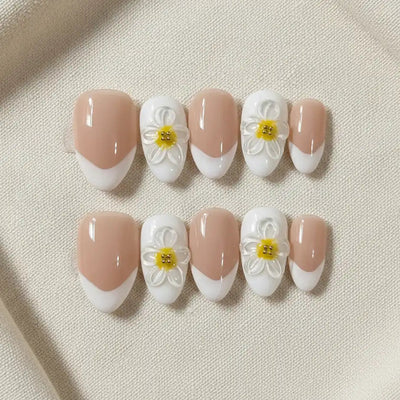
The base colour is doing more work here than the motif. Cottagecore reads wrong on a bright white or a cool pastel; it needs a slightly muddied, warm-shifted base -- cream rather than white, sage rather than mint, butter rather than lemon -- because the whole reference is dyed fabric and garden light rather than anything synthetic. Motifs should be small and slightly imperfect. A wildflower is three or four dots of colour with a dotting tool and a single green stroke, not a botanical illustration; the charm comes from looking hand-done, and a too-precise flower reads as a decal. Gingham is the one motif that needs precision: two sets of evenly spaced parallel lines crossed at right angles, with the overlaps left to darken naturally rather than painted in. A matte or soft-satin finish suits the aesthetic better than gloss, which makes the whole thing look like plastic fruit.
How to wear
Short and round is the shape, and it is not a stylistic preference so much as a requirement -- the aesthetic is built around hands that do things, and a long pointed nail contradicts it immediately. It sits with cotton prints, linen, straw and old gold, and it works particularly well for spring and early summer daytime occasions: markets, garden parties, anything outdoors before evening. Because the motifs are small and low-contrast, this is a set that rewards being seen up close and disappears at a distance, which makes it a poor choice if you want your nails noticed across a room. It is, on the other hand, one of the most office-tolerable decorated manicures, because the muted palette keeps it from registering as nail art at all.